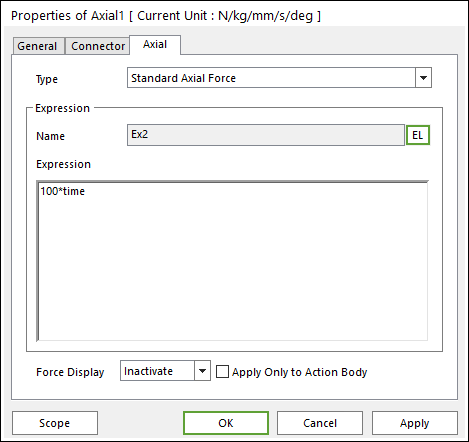
The user can define the magnitude and direction of force for the force entity. This page differs according to each force entity type.
Figure 1 Force property page [Force page]
•Type: Choose the type to input the force as Standard or User Subroutine.
•Standard: Defines by using Function Expression. For more information, click here.
•User subroutine: Defines by using User Subroutine. For more information, click here.
•Expression: Creates an expression of a force. If the user defines the expression, the substance of expression is shown in the text box.
•Force Display: Graphically displays the resultant force vector on Working Window. The displayed force can be defined as shown in Figure 2.
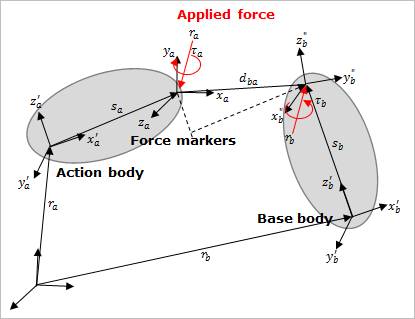
Figure 2 Definition of force
•Inactive: The graphical force display is inactivated.
•Action: The force and torque which is generalized on the force marker of the action body by a force are displayed at the position. The displayed force can be defined as following equations.
o Plate force
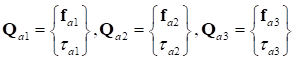
o Tire force: The displayed force is a generalized force on the tire marker by tire contact force.
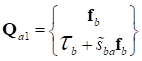
o Others

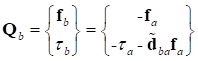
•Base: The force and torque which is generalized on the force marker of the base body by a force are displayed at the position. The displayed force can be defined as following equations.
o Spring, Rotational Spring, Axial, Translational, Rotational, and Screw forces
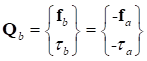
o Bushing, Beam, and Matrix forces
o Plate force
o Tire force: None
•Both: This simultaneously displays the action and reaction forces at the positions of the force markers of each body.